
Dyer County Criminal Court Cases
Dyer County divides criminal matters by court level. The 29th Judicial District Criminal Court hears felony indictments, trials, pleas, and sentences. General Sessions Court handles misdemeanors, warrants, initial appearances, and preliminary steps in felony matters. Both county channels operate through the courthouse at 101 W. Court Street in Dyersburg. A city citation can begin in Dyersburg, Newbern, or Trimble City Court, but a bind-over or later indictment moves the case into the county system.
The Dyer County Circuit Court Clerk is the custodian for Circuit and Criminal Court files. General Sessions has its own clerk line. Dyer County court records answer a different question from jail or police records: they show what charge was actually filed and how the court resolved it. A booking sheet may preserve the intake allegation, but it cannot establish the final count, plea, verdict, or sentence.
The Dyer County offices directory identifies the two clerk channels and their contact details.
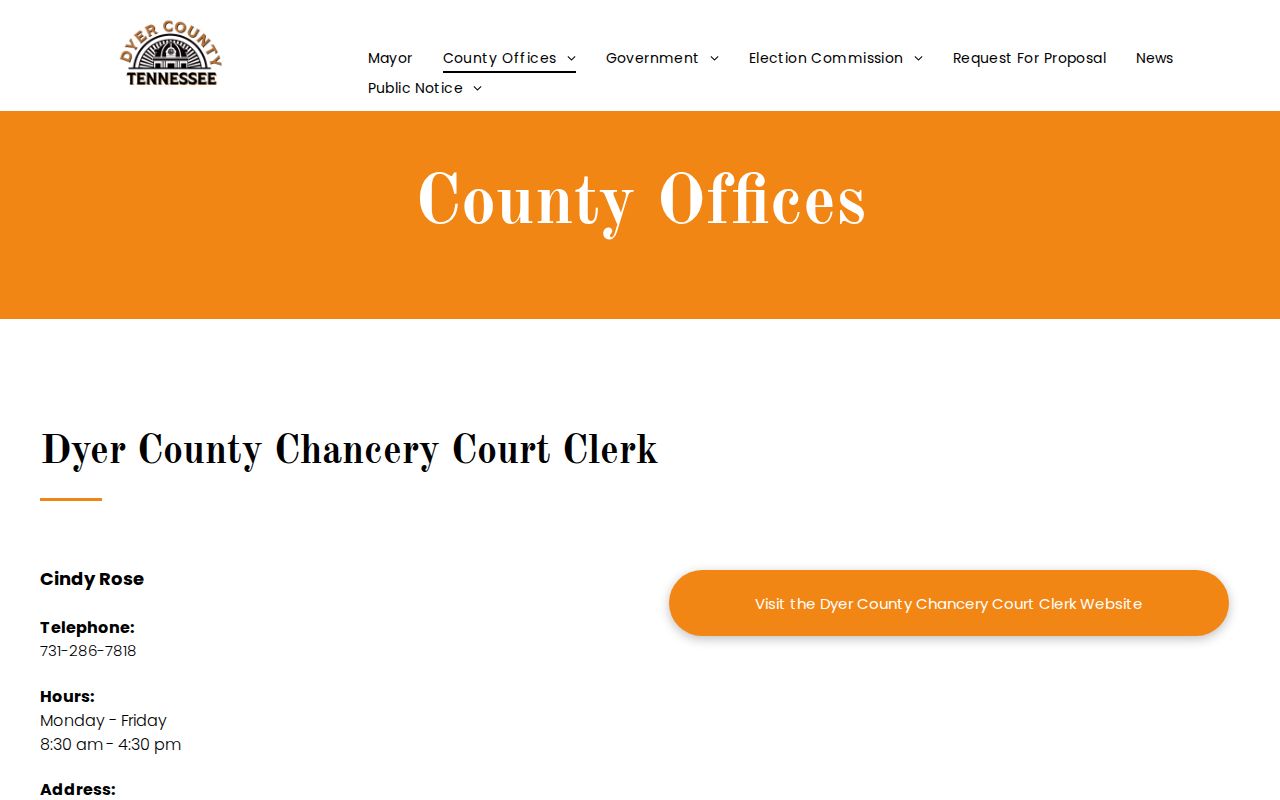
The directory helps a searcher choose the Dyer County criminal clerk before calling or visiting, which reduces the risk of requesting a felony judgment from the wrong desk.
Choose the Dyer County Case Clerk
For a Dyer County felony indictment, judgment, sentencing order, or Criminal Court docket, contact Circuit Court Clerk Tom “TJ” Jones in Room 200 at 731-286-7808. The counter is open Monday through Friday from 8:30 a.m. to 4:30 p.m. For a misdemeanor file, warrant docket, or preliminary felony proceeding, call General Sessions at 731-286-7809. When the court level is unknown, describe the charge, approximate year, and where the citation or arrest began. The Dyer County clerk can confirm whether that office holds the file.
Circuit and Criminal Court Clerk
101 W. Court St., Room 200
Dyersburg, TN 38024
731-286-7808
Monday through Friday, 8:30 a.m. to 4:30 p.m.
General Sessions Clerk
101 W. Court St.
Dyersburg, TN 38024
731-286-7809
Call for the current counter procedure.
Ask for the docket sheet, charging instrument, judgment or disposition, sentence, and a current quote for copies or certification. Dyer County does not publish a criminal copy or search fee, so do not assume the amount before ordering.
Searching Dyer County Case Records
No official public Dyer County trial-docket portal was found in the Dyer County or Tennessee court sources. The most complete search therefore runs through the clerk by counter, phone, or a written copy request. A full name and approximate year can start the Dyer County search, while a case number is best when available.
- Decide whether the matter is a felony case, misdemeanor case, or city citation.
- Call the Circuit Clerk for felony merits or General Sessions for misdemeanors and preliminary felony steps.
- Give the full name, court if known, approximate filing year, and case number when available.
- Request the docket, charging instrument, orders, judgment, sentencing record, and any certification needed.
- Confirm the copy fee and delivery method before authorizing a paid request.
Mail can be useful when a visit is not practical, but first call for current instructions. The official Tennessee courthouse directory confirms that the Dyer building serves Circuit, Criminal, and Chancery matters.
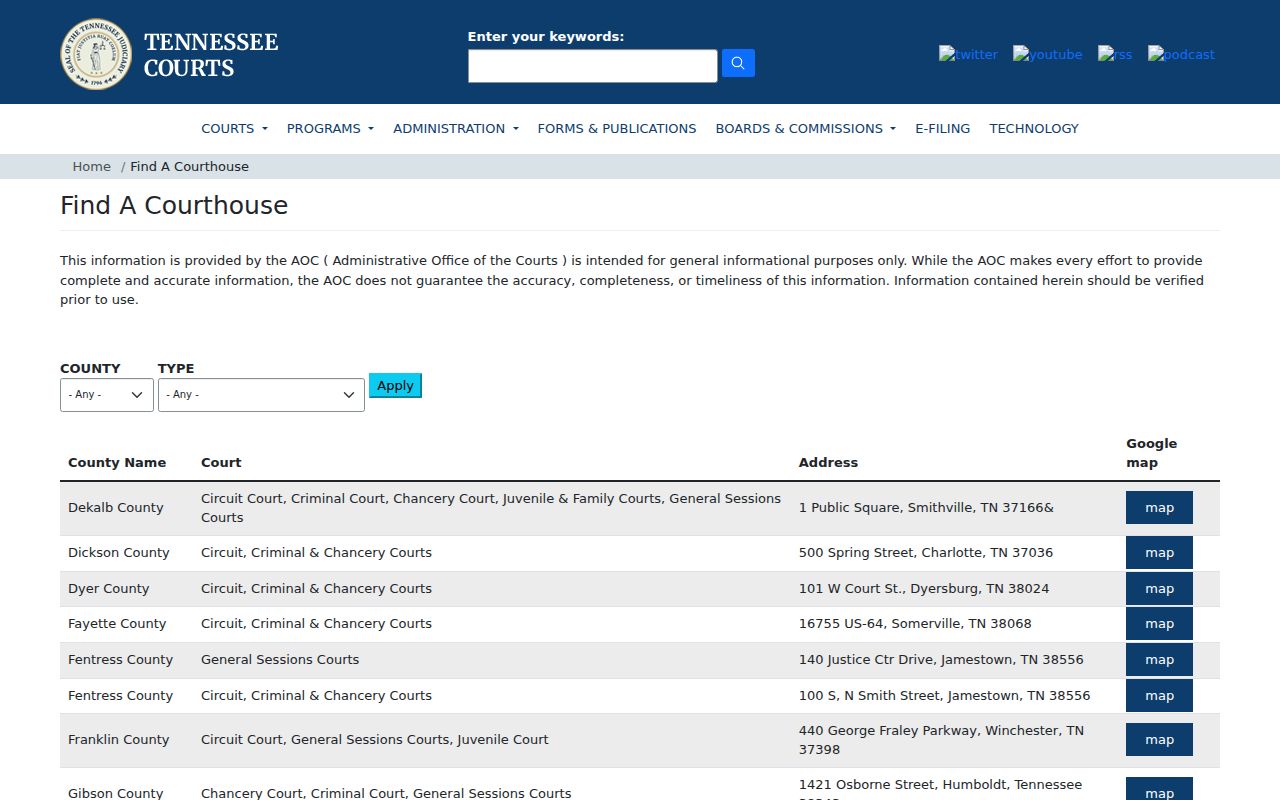
That listing verifies the courthouse identity, but the Dyer County clerk remains the source for the actual Dyer County criminal case file.
Dyer County Trial Versus Appeal Search
Tennessee Public Case History covers the Supreme Court, Court of Appeals, and Court of Criminal Appeals. It does not provide a statewide public search of Dyer County trial dockets. Use it only when a local case reached an appellate court or when an opinion can add context to the trial result.
| Field or Control | Type | Required | Use |
|---|---|---|---|
| Full text or title | Text | No | Search opinion language or title terms |
| Case number | Text | No | Find a known appellate sequence |
| County | Dropdown | No | Select Dyer as the originating county |
| Authoring or originating judge | Filter | No | Narrow by judicial officer |
| Filed date start and end | Date | No | Limit the opinion period |
| Court or category | Filter | No | Choose the appellate court type |
A Dyer County appellate opinion may list the originating court, indictment counts, plea or verdict, sentence, issues on appeal, judges, and appellate disposition. It does not reproduce every motion or docket entry held by the local clerk.
Note: A statewide appellate result is a supplement, not proof that the complete Dyer County trial file is online.
Inside a Dyer County Case File
A Dyer County criminal case file records the legal life of the prosecution. The most useful document depends on the question. A Dyer County docket gives the timeline. The charging instrument states the filed allegation. A judgment supplies the outcome, while a sentencing order states the punishment and terms imposed. Ask for a certified disposition when an authoritative outcome record is needed for personal review or correction.
| Case Number and Court | Identifies the file, court level, and local docket. |
|---|---|
| Charging Document | Shows a complaint, warrant, information where allowed, or grand-jury indictment. |
| Docket Entries | Lists filings, hearings, motions, orders, and other events in date order. |
| Bond and Hearing Dates | Records release terms and scheduled court events when public. |
| Disposition and Judgment | Shows dismissal, nolle prosequi, acquittal, plea, verdict, or other result. |
| Sentence and Conditions | States custody, probation, fine, costs, restitution, or other court-ordered terms. |
Protected victim and minor information, sealed material, and sensitive identifiers may be removed from a public copy. The remaining file can still show why a booking charge differs from the final result.
Dyer County Charges Change by Stage
A charge label can change as a Dyer County case moves forward. Police and jail staff record the allegation used at arrest and intake. A prosecutor then decides what to file or present. The grand jury may return a true bill, which is an indictment, or a no-bill, meaning it declined to indict. Later, a count may be amended, reduced, dismissed, resolved by plea, or decided at trial.
- Nolle prosequi
- The prosecutor formally chooses not to proceed on a charge.
- No true bill
- The grand jury declines to return an indictment.
- Disposition
- The recorded outcome of a charge or case.
- Judgment
- The court record that states the adjudicated result and often the sentence.
For outcome research, rely on the judgment rather than an older booking allegation. The related Dyer County arrest lookup can help identify the arresting agency or booking event, but it does not replace the court's disposition.
How a Criminal Case Moves
Most felony paths start with an arrest or warrant and an initial General Sessions appearance. A preliminary hearing may follow. The grand jury then decides whether probable cause supports an indictment. An indicted case proceeds to Criminal Court for arraignment, pretrial motions, and a plea or trial. Sentencing follows a conviction, and an appeal may follow the final judgment. Misdemeanors can be adjudicated in General Sessions without that full felony path.
Case flow: Charges Filed → Arraignment → Pretrial → Plea or Trial → Disposition → Sentencing
Dyer County's 29th Judicial District local rules add process details. Written responses must be furnished to the court, counsel must consult to place motions on the docket, and defendants generally must attend motion hearings unless a waiver is approved. Probation-violation and bail hearings are set in open court. Once a trial date is set, the court may impose deadlines for motions, jury instructions, and pleas.
Dyer County Criminal Case Classes
Tennessee uses five felony classes and three misdemeanor classes under TCA §40-35-111. Dyer Criminal Court handles felony merits, while General Sessions handles misdemeanors and early felony proceedings. Special statutes can alter a range, especially for drug offenses, so the statute and judgment tied to the exact count control.
A felony intake label is preliminary. The filed charge or indictment states what the prosecution advanced, and the judgment shows the class of conviction, if any. An unspecified felony generally defaults to Class E, while an unspecified misdemeanor generally defaults to Class A. That classification can also matter when a person later reviews possible expungement eligibility.
Case Record Access & Restrictions
Tennessee Supreme Court Rule 34 generally permits inspection of court case, judicial, and administrative records, subject to stated exceptions. Sealed documents, judicial drafts and deliberations, protected records, and internal case-management data are not public. The Tennessee Public Records Act also recognizes confidentiality exceptions and lawful redaction of sensitive data.
Access rule: Ask the Dyer County clerk for the public docket and available filed documents. A missing online result does not prove that no case file exists.
If the case ended in dismissal, nolle prosequi, no true bill, acquittal, or another qualifying result, access and expungement are separate questions. Start the removal process in the Dyer court that handled the case. The Tennessee courts expungement workflow explains how an entered order reaches the arresting agency, jail, Tennessee Department of Correction, and TBI.
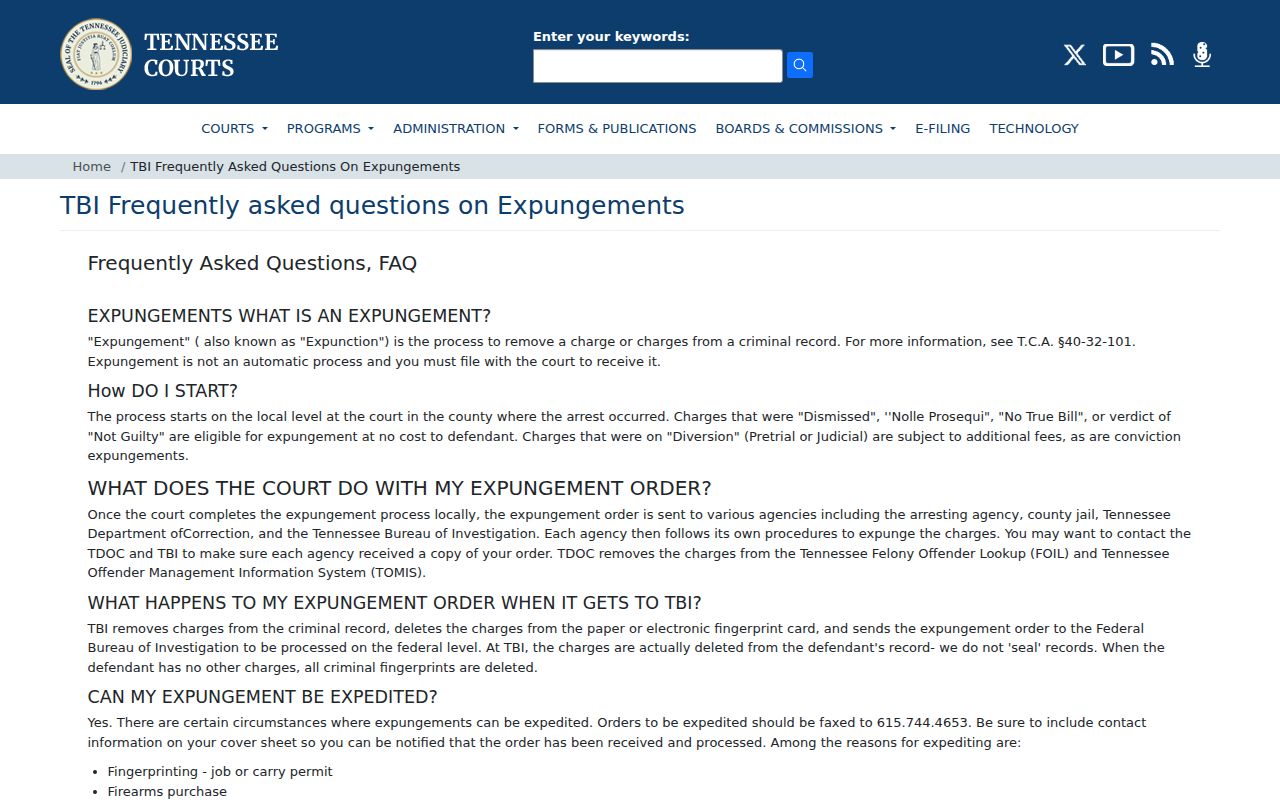
The workflow shows why a favorable result does not itself erase every record. The clerk's disposition is the starting proof, and the formal order drives deletion by the listed agencies.
Dyer County Federal Case Boundary
A federal prosecution tied to Dyer County will not be filed in Room 200 merely because the event occurred locally. Dyer County lies in the U.S. District Court for the Western District of Tennessee. Federal dockets and documents are obtained through PACER after registration, while the Western District of Tennessee provides the official court route.
This boundary matters when a county clerk search yields no indictment despite a known federal prosecution. Use the court that created the record. The county clerk holds state and local court files, not federal indictments, and the Tennessee appellate search does not replace PACER.
Note: Confirm federal fees and waiver rules inside PACER at the time of use because those terms can change.